As an Amazon Associate, we earn from qualifying purchases. Some links on this site are affiliate links at no extra cost to you. Our recommendations are based on thorough research and editorial judgment.
Why Are Drones Banned in Airports? Safety and Security Explained

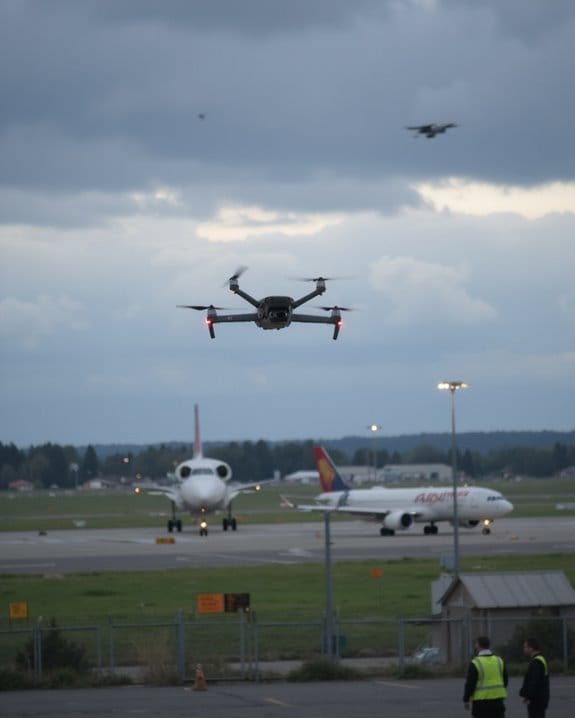
You can’t fly drones near airports because even one drone can put planes, passengers, and daily operations at serious risk. Airports use strict bans and advanced detection tech—like radar, cameras, and jammers—to prevent accidents, costly delays, and security breaches. Drones can hit aircraft, disrupt flights, and cause havoc like Gatwick’s £50 million shutdown. Think of airports as VIP lounges for safety—no uninvited UAVs allowed. Next up, you’ll see how airports tackle these challenges with cutting-edge solutions.
Key Takeaways
- Drones can collide with aircraft during takeoff or landing, risking catastrophic damage and passenger safety.
- Unauthorized drones cause major flight delays and costly airport shutdowns, as seen in incidents like Gatwick Airport’s 2018 disruption.
- Drones can evade traditional detection, posing serious security threats and potential for intentional misuse near sensitive airport zones.
- Airports operate in controlled and restricted airspace, making drone incursions a violation of strict safety regulations.
- Advanced detection and counter-UAS systems are essential to prevent drones from disrupting airport operations and breaching security.
Understanding Airspace and Why It Matters at Airports
You may be interested


Ever wondered why you can’t just fly a drone near an airport? It all comes down to airspace management and security. Airports operate within controlled airspace—think of it as an invisible shield—where air traffic control (ATC) coordinates every takeoff and landing. Here’s why unmanned aircraft systems (UAS) are restricted:
Key Considerations:
- Security: ATC needs to prevent conflicts, ensuring every aircraft, manned or unmanned, stays safe.
- Airspace Zones: Regulations change based on altitude, proximity to the runway, and airport complexity.
- Military Overlaps: Some airports share airspace with military zones, adding another layer of restriction.
For drone pilots:
- Don’t assume all airspace is equal.
- Always check local rules before launching your UAS.
- Remember, airport airspace isn’t your average sky—it’s highly regulated for a reason!
- Choosing drones with built-in geofencing helps pilots automatically avoid restricted airport zones.
The Drone Threat: How Unauthorized UAVs Endanger Airports
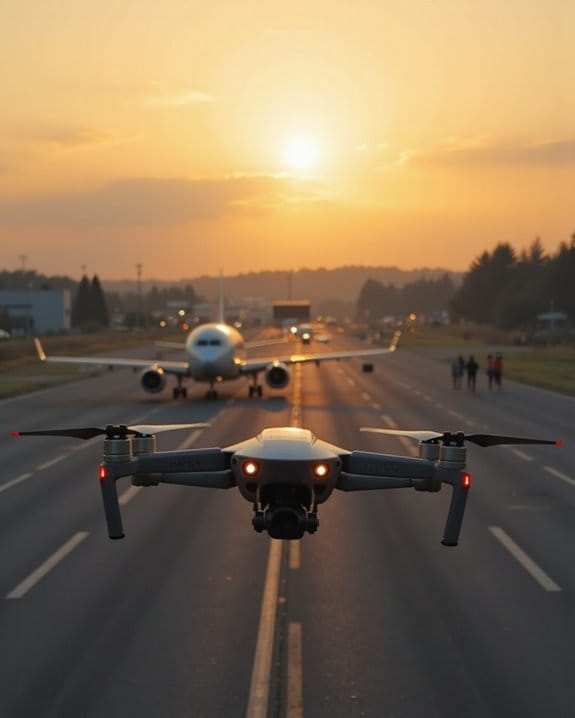
How can something as small as a hobby drone bring a busy airport to a halt? The answer lies in the potential threats these unauthorized UAVs pose to safety and security. Even inexpensive drones can cause chaos—just look at the Gatwick Airport shutdown, which cost over £50 million and disrupted thousands of travelers.
Here’s how unauthorized drones endanger airports:
- Physical damage: Drones can strike aircraft engines or critical structures, risking emergency landings.
- Operational disruption: Pilots and law enforcement report over 100 sightings monthly, leading to flight delays and logistical headaches.
- Security breaches: Dark drones evade detection, slipping through traditional systems.
- Intentional misuse: Whether for sabotage or thrill-seeking, unauthorized UAVs allow bad actors to exploit vulnerabilities.
Clearly, the drone threat isn’t just science fiction—it’s an urgent reality. Effective countermeasures often involve frequency jamming and GPS disruption to neutralize such threats before they escalate.
Recommended Products

🔍 AI-Powered 7-in-1 Privacy Protection — Find Hidden Cameras, Listening Devices & GPS Trackers Anywhere: This hidden camera detector combines four professional detection modes in one compact device: RF signal scanning (100MHz–8GHz) to catch wireless spy cameras and Wi-Fi bugs, infrared scanning to spot pinhole camera lenses, magnetic field detection to locate GPS trackers on vehicles, and a built-in flashlight for low-light inspections. Perfect for sweeping hotel rooms, Airbnb rentals, bathrooms, fitting rooms, and offices, giving you instant peace of mind wherever privacy matters most.

【Professional Hidden Camera Detectors】Our camera detector has 3 powerful detection functions: 1. Camera Detector: such as wireless cameras, wired hidden cameras and eavesdropping devices;2. GPS Finder: can detect the presence of magnetic fields generated by GPS trackers; 3. Infrared detection: looks for hidden cameras with night vision capabilities.
Counter-UAS Technology: Tools and Strategies for Drone Detection
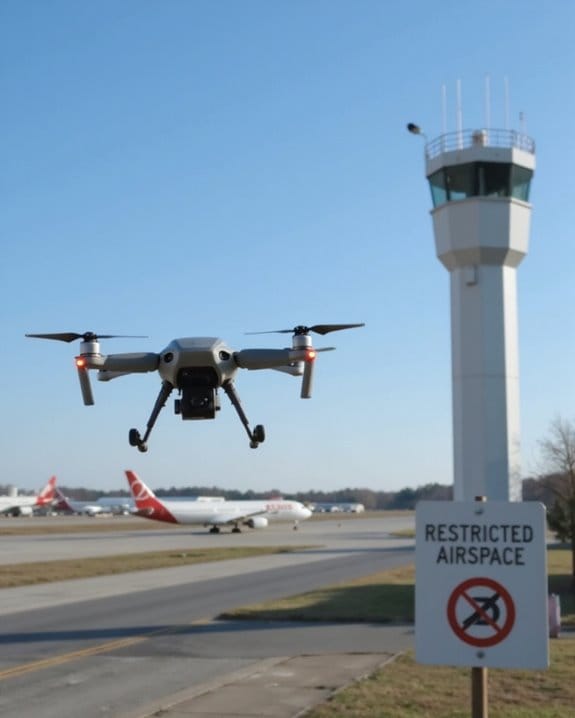
When it comes to securing airport airspace, there’s no room for guesswork—counter-UAS (Unmanned Aircraft Systems) technology delivers the precision airports need. You’ll find a mix of cutting-edge tools at work: radar, cameras, radio frequency analyzers, and acoustic sensors. Each plays a critical role in drone detection, but let’s break it down:
Key Tools and Strategies:
- Radar: Tracks fast-moving drones over large distances.
- Acoustic Sensors: Listen for the unique sounds of UAVs, distinguishing them from birds.
- Cameras: Provide visual confirmation, day or night.
- RF Analyzers: Detect drone communications.
Airports like Heathrow and Dublin invest in multi-layered systems, combining these tools for maximum coverage. Not every radar is up to the task—layering detection methods guarantees you don’t miss a thing. Additionally, effective countermeasures often target key signal frequency bands like 2.4GHz and 5.8GHz to disrupt unauthorized drone operations.
Recommended Products

【Drones with 4K Camera & Obstacle Avoidance】Our XT555 drones with camera for adults 4k are equipped with a 90° adjustable lens and 120° wide-angle lens, allowing you to capture from multiple angles with ease. 5GHz FPV transmission delivers a smooth and stable videos even in high-speed or strong-wind conditions. An SD card and card reader are included for easy storage and sharing of photos and videos. In addition, our XT555 drone is equipped with 4-way obstacle avoidance (Only work indoor), which can automatically detect and avoid obstacles during flight, effectively reducing the risk of collision

1080P Adjustable Camera Drone: Break Free from Fixed Perspectives! Featuring a 1080P HD camera with a 90° motorized adjustable lens, our FPV drone gives you the freedom to capture breathtaking shots from sweeping horizons to top-down bird's-eye views - at the touch of a button. Connect to the "DAZLEN FPV" App for real-time live streaming via FPV technology. Experience aerial exploration from a pilot's perspective, and share your unforgettable moments instantly on social media.

【𝐋𝐢𝐠𝐡𝐭𝐰𝐞𝐢𝐠𝐡𝐭 𝐚𝐧𝐝 𝐋𝐞𝐯𝐞𝐥-𝟓 𝐖𝐢𝐧𝐝 𝐑𝐞𝐬𝐢𝐬𝐭𝐚𝐧𝐜𝐞】ATOM SE drone weighs 𝐥𝐞𝐬𝐬 𝐭𝐡𝐚𝐧 𝟐𝟒𝟗𝐠, 𝐧𝐨 𝐧𝐞𝐞𝐝 𝐟𝐨𝐫 𝐅𝐀𝐀& 𝐑𝐞𝐦𝐨𝐭𝐞 𝐈𝐃 𝐑𝐞𝐠𝐢𝐬𝐭𝐫𝐚𝐭𝐢𝐨𝐧. The fold-up design packs up small enough to fit in a jacket pocket. Built-in 𝐛𝐫𝐮𝐬𝐡𝐥𝐞𝐬𝐬 𝐦𝐨𝐭𝐨𝐫 makes the drone 𝐫𝐞𝐬𝐢𝐬𝐭 𝐥𝐞𝐯𝐞𝐥-𝟓 𝐰𝐢𝐧𝐝 and fly stably
Real-World Incidents: Airport Responses to Drone Disruptions
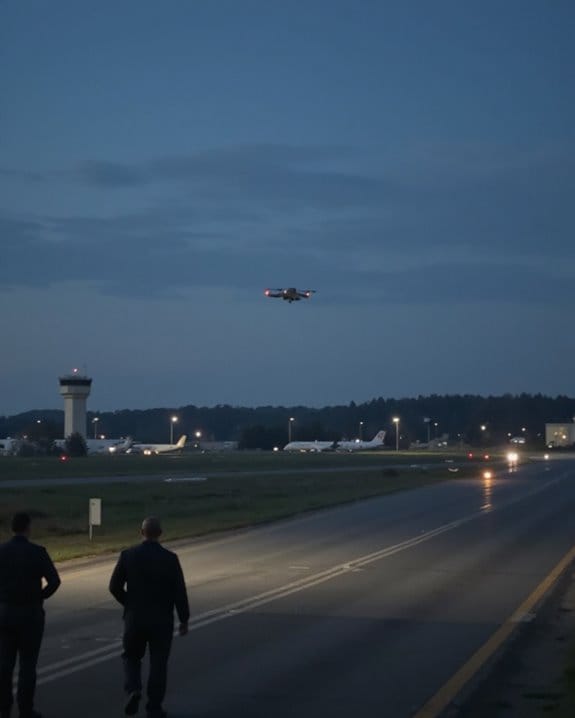
Disruption isn’t just a buzzword—it’s the reality airports face when drones stray into restricted airspace. When unmanned aircraft systems (UAS) enter critical zones, chaos can follow. Consider these real-world incidents:
Gatwick Airport (UK, 2018)
- 36-hour shutdown from drone incursions
- Over £50 million lost
- Security of passengers and operations jeopardized
Dublin Airport (2023)
- Six closures in eight weeks
- Multiple 30-minute flight delays due to UAS sightings
Heathrow Airport (London)
– Counter-UAS radar installed to maintain passenger safety
Gimpo International (South Korea)
– Invested $1.5 million in detection systems
These cases show why airports act swiftly when UAS are spotted. Your safety, along with smooth airport operations, depends on rapid, effective responses to these airborne intruders.
Recommended Products

✅ Real-Time RI Drone Detection: Instantly detects drones using remote ID radio frequency (RI) signals – even when drones aren’t visible

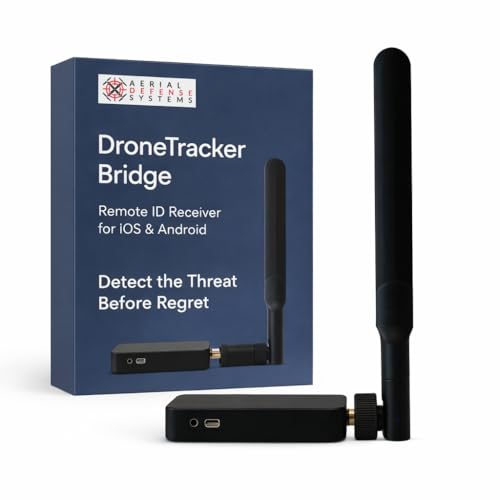
REAL-TIME PRESENCE AWARENESS Track drones as soon as they enter your airspace with instant detection alerts. Know when and where an unmanned aircraft shows up — not hours later.
Enhancing Airport Security: The Role of Advanced Counter-UAS Systems
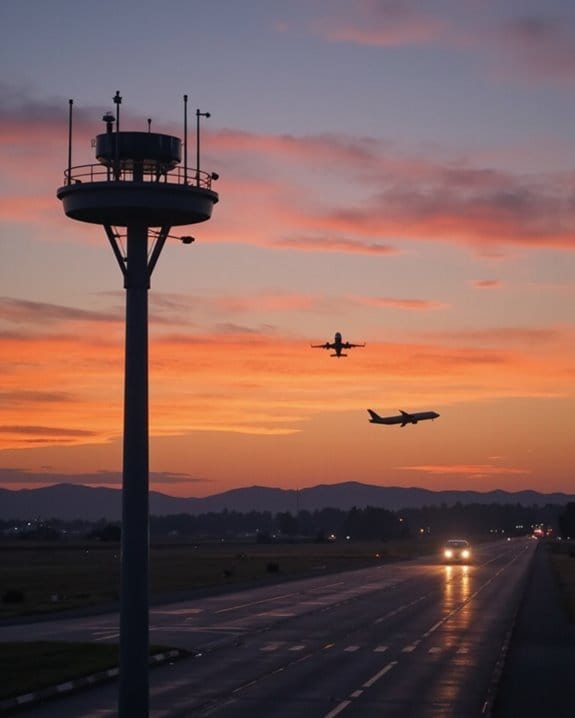
Ever wonder what keeps airports one step ahead of rogue drones? The answer lies in advanced Counter-UAS systems. These platforms combine radar, detection sensors, and jammers to spot and intercept unmanned aircraft systems (UAS) before they threaten safety or disrupt operations.
Key Features:
- Real-Time Situational Awareness: Track multiple fast-moving targets, distinguishing drones from birds or debris.
- Command and Control Integration: Perimeter alarms are prioritized, ensuring rapid decision-making.
- Mitigation Tools: Jammers prevent unauthorized UAS from entering restricted zones.
Heathrow’s radar-based approach and Dublin’s rapid deployment after repeated closures prove these systems’ effectiveness. Gimpo International’s $1.5 million investment shows their global necessity. For airports facing frequent UAS sightings, investing in such tech isn’t just smart—it’s essential for keeping the airspace clear and your travel plans on time.
Recommended Products

【Compatibility】Universally Drone Airdrop System, for Mavic Mini5 Pro/Mini4/Mini3/Mini2/Air2/Air2S/Mavic4/Mavic 3/Mavic 2 Series Drone/Spark.(Note: but not suitable for phantom 3/4 &Inspire1/2 drone)

【Compatibility】Universally Drone Airdrop System, for DJI Mini5 Pro/Mini4/Mini3/Mini2/Air2/Air2S/Mavic4/Mavic 3/Mavic 2 Series Drone/Spark.(Note: but not suitable for phantom 3/4 &Inspire1/2 drone)

【Effective Release Distance Exceeding 1km】The effective release vehicle of the drone is controlled by a separate remote control, and the remote control signal distance is within 1 km.
Frequently Asked Questions
What Are the Safety Concerns of Drones?
You’ve got to worry about drones colliding with planes, damaging engines, or disrupting emergency landings. They’re hard to detect, especially “dark” drones, so you can’t always stop them before they threaten passenger safety or airport operations.
How Do Drones Affect Airports?
Imagine a single pebble causing ripples across a calm pond—that’s what drones do to airports. You’ll see delayed flights, disrupted schedules, and costly security upgrades, all because drones can threaten both safety and smooth operations.
Why Can’t You Fly Drones Near Airports?
You can’t fly drones near airports because they’re a serious hazard to planes and passengers. If you ignore the rules, you risk causing collisions, shutdowns, and possible legal trouble. Authorities use advanced systems to detect and stop unauthorized drones.
Are Drones Allowed Through Airport Security?
Picture airport security like a fortress—you can’t just stroll through with a drone. They’re usually banned at checkpoints, and unless you’ve got special permission, you’ll likely have to leave your drone behind for everyone’s safety.